Friday, November 27, 2015

Death

Death. It’s a natural experience that everyone goes through and knows of. We all have to die some day, it’s just a matter of when and where it will happen. Death can cause many changes in someone’s life after the fact. Some people are never the same after someone they love passes away.
Hurston uses death as a symbol for the character Janie in the novel Their Eyes Were Watching God starting with her grandmother’s death. Janie always respected her grandmother when it came to her opinions and statements because that was the person who raised her. She always appreciated her for being there since her mother couldn’t. Janie’s grandmother dying brought out a little bit of courage in her. Janie finally breaks it off with her husband Logan after she was promised by her grandmother that she was “gointer love him,” (Hurston 23). janie stayed with Logan because she knew it meant security to her grandmother. Since she n0 longer had to worry about her grandmother, she could focus on herself.
Another instance of death used by Hurston to represent change in Janie’s life is the death of Joe Starks in chapter 9. Janie not only goes through emotional change, but physical change as well. She “burnt up every one of her head rags,” (Hurston 89) and began wearing her hair in a chunky braid. It seemed as though Janie was nonchalant about the whole situation.Hurston does a good job of writing this chapter because the reader is able to see Janie’s progression of emotions and thoughts of her grandmother. Hurston does a great job of using imagery to really imagine what Janie is feeling.
Many people can relate to Janie since people die every day and experience the same feelings grievances.

Major Turning Point

The turning points in the story is when Mrs. Tony goes to the store and “makes a fool” out of her husband, and when Janie’s second husband, Joe Starks, dies.
Throughout Janie’s marriage with Joe, Janie is faced with hardships consisting of a general consensus that a woman’s place is in the household and that a woman should stay in her place. She finally becomes independent.
Just before Joe Starks dies, Janie listens to a conversation between Coker, Joe Lindsay, and Jim Stone after Mrs. Tony goes into Starks’ store and makes a scene about her husband not getting enough food for her and her children. Coker says, “Ah could break her if she wuz mine. Ah’d break her or kill her. Makin’ uh fool outa me in front of everybody” (Hurston 76). This event serves as a turning point because this makes Janie think about how Joe beats her when she says or does something out of place, like cooking incorrectly when the bread doesn’t rise (Hurston 72), which in turn makes Janie speak up and tell them what she thinks about the subject, that they don’t know half as much about women as they think they do (Hurston 75).
When Joe dies, Janie says, “Come heah people! Jody is dead. Mah husband is gone from me” with almost no sorrow in her tone(Hurston 87). This serves as a major turning point because at this point in the story, Janie has been through two, (for the most part) unhappy, marriages and finally begins to do what she wants with her life instead of having a husband tell her what to do. The story so far has been like Janie’s journey trying to find independence for herself and now she has finally found it.

A Strand of Power

Webster’s definition for power goes as followed: the ability or right to control people or things. Could hair however possess the power to control men? In Janie’s case her majestic “Caucasian” hair does. In multiple scenarios Janie’s hair has been brought to the reader’s attention, the strands coming from her scalp represents the control and strength she casted over Jody as well as other men. Janie’s long hair had first been introduced when she returned home. Her hair was untied and let loose, reflecting her attitude from the inside out. In her first marriage Janie’s hair was never brought to attention, but the marriage with Joe Stark’s proved to do otherwise. Jody noticed the men stared at Janie’s luscious hair and longed to touch it, “she was there in the store for him to look at, not those others” (Hurston 55). Jody the jealous, sees the stares and forces Janie to tie back her hair. The symbol of power, and independence that Janie has the ability to possess is pulled back after the use of the first head wrap.
Janie’s hair not only signifies her power to control men, but also illustrates her Caucasian ancestors that lie within her. The long hair represents Janie as being part white, furthering her identity as being more than just colored. After Jody’s death Janie finally let her hair fall against her skin "tearing her handkerchief from her head and let down her plentiful hair." Like the apron before, here she is freeing herself from the shackles of the marriage” (Hurston 83). As the reader, we are able to conclude that Janie’s hair was her best feature, when she had her hair tied back she felt lost, when it was set free she felt alive. The ability to key into her own identity was prominent when her hair hit her back. Her hair was a symbol of herself, when it was left alone and let free it felt most alive, yet many tried to tie it back and withhold its beauty. 


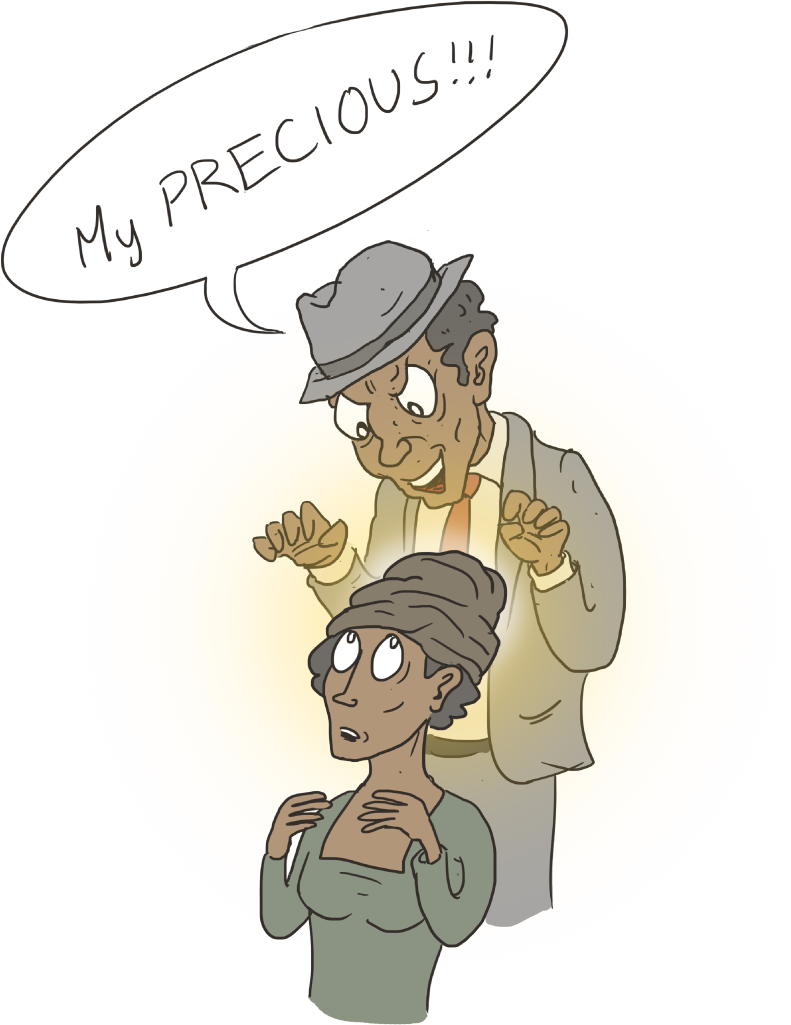
This picture illustrates Jody’s obsession with Janie’s hair, and the control it has over him. He conceals the beauty, and keeps it’s all to himself. The head wrap portrays Janie in a different light, hiding her beautiful hair, and the power she could possess.

"Too Moufy"

       Joe Starks upholds Janie as having the highest position any wife could ask for: the "mayor's wife" (page 60), but views her as being ungrateful. This is similar to the old phrase "money can't buy happiness". The way Starks sees it, Janie is in a "high chair" - a position that "too many women would be glad to be in," yet all she does is sit and look "sullen." (page 62) Janie would much rather be an equal to her husband than to be a product of his success. Joe Starks would rather Janie be a trophy around the store than a partner by his side. This contrast is evident in every disagreement that comes about. Arguments that usually end in Janie pointing out Joe's present fault, Joe explaining why what she said is not a fault, and Janie agreeing with him even though "She didn't change her mind but she agreed with her mouth," anyway.(page 63) 
     The phrase "money can't buy happiness" is very similar to Janie and Joe Starks' marriage because Janie's town position isn't making her happy. In actual fact she would much rather be an ordinary townswoman if it meant that she could voice her opinion freely around her husband, and more importantly, to her husband. All Janie received from her husband was "what money could buy" (page 76), when really she didn't ask for much, especially not materialistic things.  And, ultimately, her true desires built up and finally forced her to do what she "had never done before...thrust herself into the conversation." (page 75)
           'Well, it would seem that the mayor's wife is entirely "too moufy."' (page 75)

Hassan


As Jody’s control and influence continues to pollute their marriage, Janie remains silent. “No matter what Jody did, she said nothing” (76). Janie’s delicate attitude and inability to speak up eventually completely took over, not only her personality, but her entire life. She has become just an accessory of Jody and not a real person with her own opinions. The relationship of Jody and Janie mirrors the relationship between Amir and Hassan in The Kite Runner. Throughout The Kite Runner, Amir has a superiority complex and controlling attitude towards Hassan, which Haasan never fights or tries to stop. Always falling under the demands of Jody, Janie is very similar to Hassan.
“The years took all the fight out of Janie’s face” (76). This statement also directly relates to The Kite Runner. After some unfortunate events take place, which deeply affects Hassan, his face is changed forever. Amir states he never saw Hassan smile again. Each of these characters (Janie and Hassan) can be considered “victims” of controlling, abusive relationships, which is extremely evident through their deteriorated physical features.
The connection between these two characters can be seen throughout each of the novels. They both go through similar situations by having to deal with controlling people in their lives. However, Hassan never stands up to Amir. Because of Janie’s background and previous relationships, I believe she will ultimately stand up to Jody and face his demands with confidence. Even though on page 76 Janie is described as having “plenty of life beneath the surface but it was kept beaten down by the wheels,” she will eventually find herself again.

Jody vs. Curt Lemon: Imagery of Death

            “His eyes stared unwillingly into a corner of the room so Janie knew the futile fight was not with her. The icy sword of the square-toed one had cut off his breath and left his hands in a pose of agonizing protest” (page 87). Hurston uses the “icy sword” as imagery for Jody’s death. She uses the icy sword image because it represents how instantly death came, like a sword actually cut his breath off because one moment he was arguing, the next moment he was dead.
            Hurston’s imagery of death for Jody is very similar to Tim O’Brien’s illustration of Curt Lemon’s death in “The Things They Carried”. He writes that Lemon’s death was almost beautiful “the way the sunlight came around him and lifted him up and sucked him high into a tree full of moss and vines and white blossoms.” O’Brien also uses imagery to describe death; the sunlight represents a bobby trap bomb that Lemon stepped on and in an instant he was gone.
In contrast, Janie knew Jody was dying, but the platoon had no idea that Curt Lemon would die so suddenly. However, the two deaths are similar because they die in the blink of an eye; so suddenly that if the reader skipped a line they would’ve missed it. Both Hurston and O’Brien use imagery to portray death to create to the reader a sense of involvement from the reader, making the reader feel like they are watching the death.


The Grim Reaper is very often associated with death, which is very suiting for both texts.

Mrs.Turner

           In chapter 16, the author introduces a new character- Mrs. Turner. She is a “milky sort of woman” who has a deep hatred for “negroes” (Hurston 139). Mrs. Turner represents what is wrong with society. As a black woman who is lighter than most, she believes that the solution to fixing society is to gather people like herself and Janie to “lighten up de race” (Hurston 140). The imagery that the author uses to describe Mrs. Turner displays her personality perfectly. “Mrs. Turner’s shape and features were entirely approved by Mrs. Turner” (Hurston 140). She was happy with any part of herself that separated her from the black race. She would rather side with the white people and continue to segregate than fix the true problems in the world.
            The author uses Mrs. Turner in direct contrast with Janie. Mrs. Turner’s characterization in the novel is placed side by side with Janie’s in order to compare their views towards “negroes” (Hurston 139). In doing this, the author succeeds in showing how good Janie’s heart is. Janie is proud to be married to a black man, which disheartens Mrs. Turner. Mrs. Turner is part of a time period in which love was based on the physical features of a man rather than the emotional.
            Today, there are still issues with light skinned people feeling as if they are superior. The link below is an article introducing the concept of colourism. It directly relates to Mrs. Turner’s feelings of superiority and brings the concept into modern times.